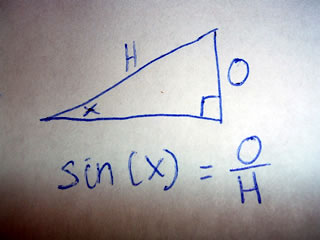
Showing posts with label sine. Show all posts

Tuesday, February 3, 2009

The Law of Sines

When we know the measure of the angles of a triangle, and the measure of one of its sides, we can use the law of sines to find the length of the other two sides.

The law sines states for any triangle with sides A,B, or C that
sin(a)/A = sin(b)/B = sin(c)/C
or equivalently
A/sin(a) = B/sin(b) = C/sin(c)

So if we have a triangle as such, with side x unknown we can find it by using the law of sines:
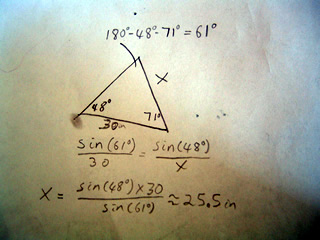
example of the law of sines

Proof of the Law of Sines
Consider the following diagram:
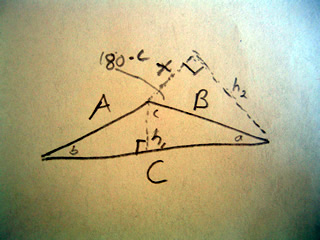
Sketch of a triangle to help prove the law of sines

In the first step of the proof we divide the triangle into two right triangles by drawing a line of length h1.

Now we have two right triangles we can say that
sin(b)=h/A or h=A*sin(b)
similarly
sin(a)=h/B so h=B*sin(a)

now we can see that
B*sin(a)=h=A*sin(b)

divide both sides by AB and we get
sin(a)/A = sin(b)/B which is the first half of the law of sines.

For the next part, we draw a right triangle out from side B, creating a new length h2.

From this new triangle we see that
sin(b)=h/C and h=sin(b)*C
we also see that
sin(180-c) = h/B or h=sin(180-c)*B

but from the unit circle below we see that sin(180-c)=sin(c)
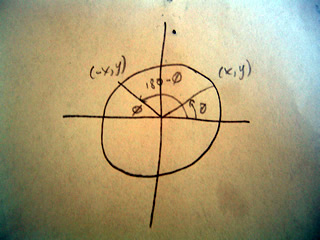
unit circle showing that 180-c = c

so we can write sin(c)*B=h and from this conclude
sin(b)*C=h=sin(c)*B
again we divide both sides by BC and get
sin(b)/B = sin(c)/C

so we have sin(a)/A=sin(b)/B=sin(c)/C which is the law of sines.

Friday, January 30, 2009

The Sine function And Circles

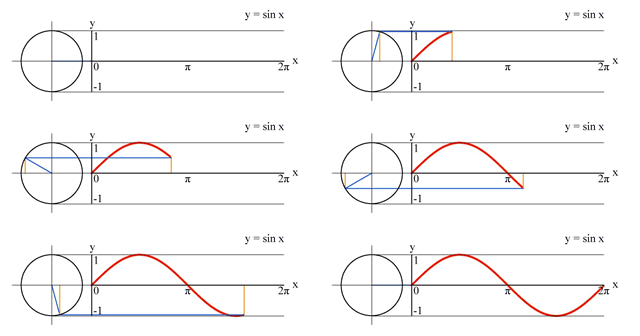
Yesterday we learned that sine is the y coordinate of any point on the unit circle. Thus if we take the circumference of the circle and place it on the x-axis from 0 to 2pi, we can evaluate sin at any point. The result is the graph that represent a stretched out circle.

Graph of the sine function from wikipedia
Graph from wikipedia.

The curve of a circle occurs many places in nature and is used to model frequencies of energy, such as electricity and sound.

Thursday, January 29, 2009

Prove that the coordinates of a particular angle on the unit circle are the cosine and sine of that angle.

Prove that the coordinates of a particular angle on the unit circle are the cosine and sine of that angle.

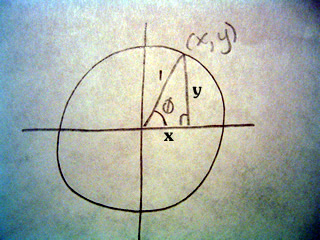
Consider the unit circle with coordinates x and y:
x,y coordinates on a unit circle

Cosine is defined as the side adjacent to the angle divided by the hypotenuse, (A/H), or in this case (x/1) so we see that cosine = x

Similarly sine is defined as the side opposite the angle divided by the hypotenuse, (O/H), or in this case (y/1) so we see that sine = 1

Thus we have proved that the coordinates of a particular angle on the unit circle are the cosine and sine of that angle, as shown below:

Unit circle with sine and cosine

Wednesday, January 21, 2009

Prove that tan(x) = sin(x)/cos(x)

Prove that tan(x) = sin(x)/cos(x)

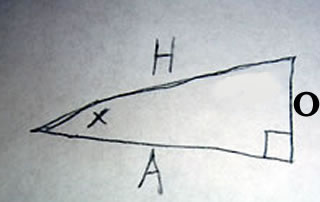
Image of a triangle with an angle x, and the opposite, adjacent, and hypotenuse, labeled

sin(x) = (0/H)

cos(x) = (A/H)

Then sin(x)/cos(x) =

(O/H)/(A/H) =

(O/H)*(H/A) =

(O/A) = tan(x)

So sin(x)/cos(x) = tan(x)

Monday, January 19, 2009

A relationship between sine and cosine

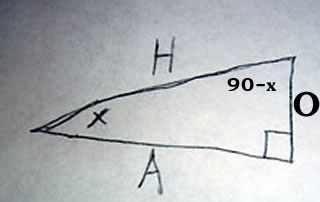
Figure used to show a relationship between sine and cosine

From the figure above the cosine of x can be defined as follows:

cos(x) = sin(90 - x)

This is because we know we have one 90 degree angle, a right angle, so the other two angles must equal 90 degrees, since the interior angles of a triangle always add up to 180 degrees. When the measure of two angles are dependent on each other in this way they can be called complements,. The name cosine originated this way, since it is the compliment of sine.

Saturday, January 17, 2009

Sine: The first trigonometric function

The sine of an angle is defined as the length of the hypotenuse divided by the length of the opposite side.

Sine function defined in a triangle

Thus if O=6 and H=10 then

sin(x) = 6/10

= 3/5