Showing posts with label trigonemtry. Show all posts

Tuesday, February 3, 2009

The Law of Sines

When we know the measure of the angles of a triangle, and the measure of one of its sides, we can use the law of sines to find the length of the other two sides.

The law sines states for any triangle with sides A,B, or C that
sin(a)/A = sin(b)/B = sin(c)/C
or equivalently
A/sin(a) = B/sin(b) = C/sin(c)

So if we have a triangle as such, with side x unknown we can find it by using the law of sines:
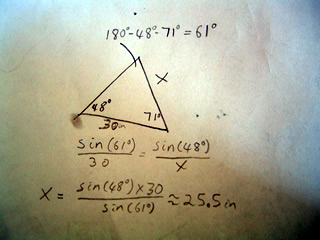
example of the law of sines

Proof of the Law of Sines
Consider the following diagram:
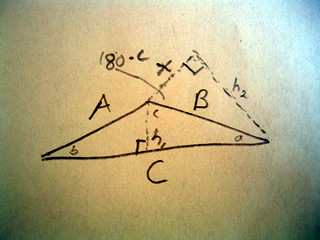
Sketch of a triangle to help prove the law of sines

In the first step of the proof we divide the triangle into two right triangles by drawing a line of length h1.

Now we have two right triangles we can say that
sin(b)=h/A or h=A*sin(b)
similarly
sin(a)=h/B so h=B*sin(a)

now we can see that
B*sin(a)=h=A*sin(b)

divide both sides by AB and we get
sin(a)/A = sin(b)/B which is the first half of the law of sines.

For the next part, we draw a right triangle out from side B, creating a new length h2.

From this new triangle we see that
sin(b)=h/C and h=sin(b)*C
we also see that
sin(180-c) = h/B or h=sin(180-c)*B

but from the unit circle below we see that sin(180-c)=sin(c)
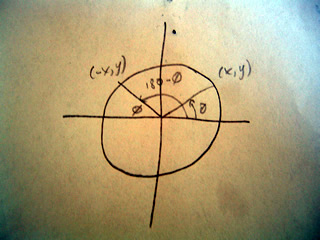
unit circle showing that 180-c = c

so we can write sin(c)*B=h and from this conclude
sin(b)*C=h=sin(c)*B
again we divide both sides by BC and get
sin(b)/B = sin(c)/C

so we have sin(a)/A=sin(b)/B=sin(c)/C which is the law of sines.

Wednesday, January 28, 2009

Finding coordinates on the Unit Circle

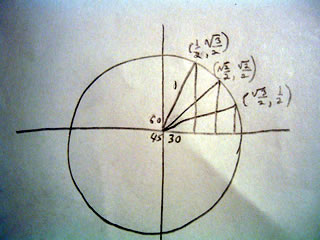
Coordinates can be found on the unit circle by inscribing 60, 45, and 30 degree triangles.

Sketch depicting triangles inscribed in a unit circle to find coordinates relative to the angle

Thus triangles with
60 degrees corresponds to the coordinate (1/2,sqrt(3)/2)
45 degrees corresponds to the coordinate (sqrt(2)/2,sqrt(2)/2)
30 degrees corresponds to the coordinate (sqrt(3)/2,1/2)


So the adjacent side makes the x axis, the opposite side makes the y axis, and the hypotenuse always equals 1.

Saturday, January 24, 2009

Prove that tan2(x) + 1 = sec2(x)

Prove that tan2(x) + 1 = sec2(x)

We know that

sin2(x) + cos2(x) = 1

dividing both sides by cos2(x) we get

(sin2(x) + cos2(x))/cos2(x) = 1/cos2(x)

which equals

sin2(x)/cos2(x) + cos2(x)/cos2(x) = (1/cos(x))2

which can be re-written as

(sin(x)/(cos(x))2 + 1 = (1/cos(x))2


We know that tan2(x) = (sin(x)/(cos(x))2

and that (1/cos(x))2 = sec2(x)

So we can write

cot2(x) + 1 = sec2(x)

Friday, January 23, 2009

Prove that sin^2(x) + cos^2(x) = 1

Prove that sin^2(x) + cos^2(x) = 1

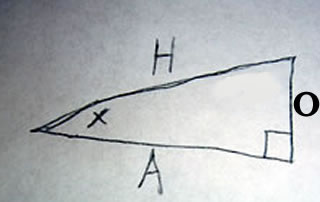
Triangle which formulas refer to

by Pythagorean Theorem A^2 + O^2 = H^2

Now, if we divide both sides by H^2 we get

(A^2 + O^2)/H^2 = H^2/H^2

which is

A^2/H^2 + O^2/H^2 = 1

which is

(A/H)^2 + (O/H)^2 = 1

now sin(x) = A/H and cos(x)=O/H so

sin^2(x) + cos^2(x) = 1

Saturday, January 10, 2009

Trigonometry: Degrees and Radians

I have decided to take up reviewing trigonometry as a goal for this blog. In the first look at trigonometry it is necessary to understand angles. Angles are create by the intersection of two lines. They can be measured in degrees or radians.

Degrees
There are 360 degrees in any possible angle, the widest angle forming a complete circle. The number 360 was chosen by the Babylonians who counted in groups of 60 (base 60) where as we count in groups of 10 (base 10). Thus 1/60th of a degree is called a minute and 1/60th of a minute is called a second. This terminology is still used by navigators today, but some also use decimals. In any case, two perpendicular lines, like in a capital L are said to have 90 degrees, a flat line ___ has 180 degrees and flipping the whole thing over completes the circle with 270 degrees and finally 360.

Radians
Radians are ways of measuring angles as they are drawing inside a circle. If we take the circumference of a circle we get C = 2(pi), thus we can draw a unit circle (circle with circumference = 1) around any angle and be able to express the measure of that angle in terms of radians. Thus the L would become (Pi/2) or 1/4 the circumference, which also equates to 90 degrees. The flat line ___ would become Pi, or half the circle, this would equate to 180 degrees.