Showing posts with label cosine. Show all posts

Thursday, January 29, 2009

Prove that the coordinates of a particular angle on the unit circle are the cosine and sine of that angle.

Prove that the coordinates of a particular angle on the unit circle are the cosine and sine of that angle.

Consider the unit circle with coordinates x and y:
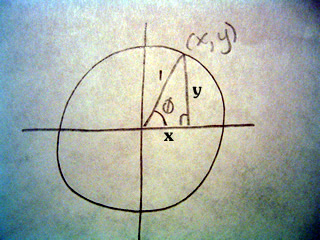
x,y coordinates on a unit circle

Cosine is defined as the side adjacent to the angle divided by the hypotenuse, (A/H), or in this case (x/1) so we see that cosine = x

Similarly sine is defined as the side opposite the angle divided by the hypotenuse, (O/H), or in this case (y/1) so we see that sine = 1

Thus we have proved that the coordinates of a particular angle on the unit circle are the cosine and sine of that angle, as shown below:

Unit circle with sine and cosine

Wednesday, January 21, 2009

Prove that tan(x) = sin(x)/cos(x)

Prove that tan(x) = sin(x)/cos(x)

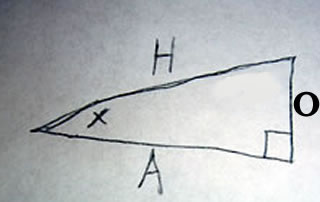
Image of a triangle with an angle x, and the opposite, adjacent, and hypotenuse, labeled

sin(x) = (0/H)

cos(x) = (A/H)

Then sin(x)/cos(x) =

(O/H)/(A/H) =

(O/H)*(H/A) =

(O/A) = tan(x)

So sin(x)/cos(x) = tan(x)

Monday, January 19, 2009

A relationship between sine and cosine

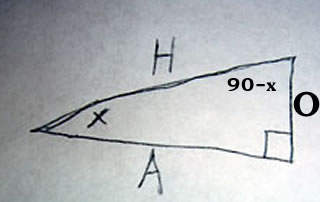
Figure used to show a relationship between sine and cosine

From the figure above the cosine of x can be defined as follows:

cos(x) = sin(90 - x)

This is because we know we have one 90 degree angle, a right angle, so the other two angles must equal 90 degrees, since the interior angles of a triangle always add up to 180 degrees. When the measure of two angles are dependent on each other in this way they can be called complements,. The name cosine originated this way, since it is the compliment of sine.

Sunday, January 18, 2009

Cosine

The cosine of an angle can be defined as the length of the adjacent side divided by the length of the hypotenuse.

Triangle representation of the cosine function

This if A=4 and H=9 then

cos(x) = (4/9)