Arcfunctions, or inverse functions, of trigonometry allow you to find the degree of an angle if you have the ratios.
Thus arcsin(1/2) = 30 degrees
since sin(30) = 1/2
this can also be written as
sin-1(1/2) = 30 degrees
The arc functions can produce more than one value, for example
arcsin(sqrt2/2) can equal 90 degrees and 135 degrees.
As we learned when we covered functions in set theory, functions can be defined on any domain, and thus, the arc functions are defined to be between -90 and 90 degrees to avoid getting more than one output. That is -Pi/2 and Pi/2 radians.
Showing posts with label trigonometric functions. Show all posts
Showing posts with label trigonometric functions. Show all posts
Saturday, January 31, 2009

Thursday, January 29, 2009
Prove that the coordinates of a particular angle on the unit circle are the cosine and sine of that angle.
Prove that the coordinates of a particular angle on the unit circle are the cosine and sine of that angle.
Consider the unit circle with coordinates x and y:
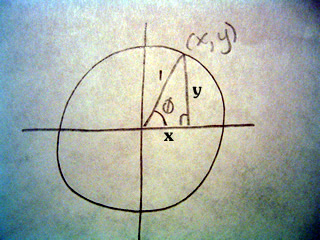
Cosine is defined as the side adjacent to the angle divided by the hypotenuse, (A/H), or in this case (x/1) so we see that cosine = x
Similarly sine is defined as the side opposite the angle divided by the hypotenuse, (O/H), or in this case (y/1) so we see that sine = 1
Thus we have proved that the coordinates of a particular angle on the unit circle are the cosine and sine of that angle, as shown below:

Consider the unit circle with coordinates x and y:
Cosine is defined as the side adjacent to the angle divided by the hypotenuse, (A/H), or in this case (x/1) so we see that cosine = x
Similarly sine is defined as the side opposite the angle divided by the hypotenuse, (O/H), or in this case (y/1) so we see that sine = 1
Thus we have proved that the coordinates of a particular angle on the unit circle are the cosine and sine of that angle, as shown below:
Tuesday, January 27, 2009
Unit Circle and Sample Angles
The unit circle is a circle with radius 1 and is used to evaluate trigonometric functions.
The unit circle can tell us the measure of any angle from the origin to an (x,y) coordinate, however, angles can be more than 360 degrees on the circle, as we see in the example.
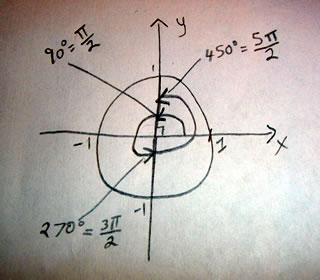
Thus at point (0,1) we have both
90 degrees or (Pi/2)
and
450 degrees or (5pi/2)
at point
(0,-1) we have 270 degrees or (3Pi/2)
Thus we see how the unit circle is used to measure angles, we will see in future posts how it relates to the trigonometric functions.
The unit circle can tell us the measure of any angle from the origin to an (x,y) coordinate, however, angles can be more than 360 degrees on the circle, as we see in the example.
Thus at point (0,1) we have both
90 degrees or (Pi/2)
and
450 degrees or (5pi/2)
at point
(0,-1) we have 270 degrees or (3Pi/2)
Thus we see how the unit circle is used to measure angles, we will see in future posts how it relates to the trigonometric functions.
Monday, January 26, 2009
Right Triangles in Equilateral Triangle
Equilateral triangles do not have right angles, making them difficult to work with in regards to trigonometric equations. This can be solved by cutting the triangle in half, thus creating two triangles.
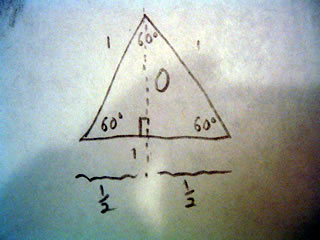
From the triangle above, we can find the length of the dotted line, 0, by pythagorean theorem.
This (1/2)2 + O2 = 12
=
(1/4) + O2 = 1
O = Sqrt(1-(1/4)) = sqrt(3/4) = sqrt(3)/2
The new angle at the top of the triangle can also be found, since all angles add up to 180, we get:
60 + y + 90 = 180
and so y=30 , exactly half of 60.
in degrees this is 30*(pi/180) = Pi/6
From the triangle above, we can find the length of the dotted line, 0, by pythagorean theorem.
This (1/2)2 + O2 = 12
=
(1/4) + O2 = 1
O = Sqrt(1-(1/4)) = sqrt(3/4) = sqrt(3)/2
The new angle at the top of the triangle can also be found, since all angles add up to 180, we get:
60 + y + 90 = 180
and so y=30 , exactly half of 60.
in degrees this is 30*(pi/180) = Pi/6
Subscribe to:
Posts (Atom)

 Posts
Posts