Arcfunctions, or inverse functions, of trigonometry allow you to find the degree of an angle if you have the ratios.
Thus arcsin(1/2) = 30 degrees
since sin(30) = 1/2
this can also be written as
sin-1(1/2) = 30 degrees
The arc functions can produce more than one value, for example
arcsin(sqrt2/2) can equal 90 degrees and 135 degrees.
As we learned when we covered functions in set theory, functions can be defined on any domain, and thus, the arc functions are defined to be between -90 and 90 degrees to avoid getting more than one output. That is -Pi/2 and Pi/2 radians.
Showing posts with label functions. Show all posts
Showing posts with label functions. Show all posts
Saturday, January 31, 2009

Tuesday, January 20, 2009
Tangent
The tangent function is defined as the length of the side opposite the angle x divided by the length of the adjacent angle.
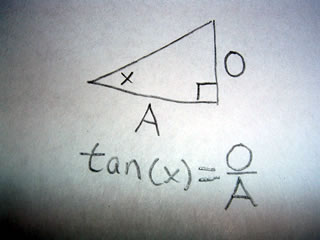
Thus if O=5 and A=3 then
tan(x)=5/3
Thus if O=5 and A=3 then
tan(x)=5/3
Sunday, January 18, 2009
Cosine
The cosine of an angle can be defined as the length of the adjacent side divided by the length of the hypotenuse.

This if A=4 and H=9 then
cos(x) = (4/9)
This if A=4 and H=9 then
cos(x) = (4/9)
Saturday, January 17, 2009
Sine: The first trigonometric function
The sine of an angle is defined as the length of the hypotenuse divided by the length of the opposite side.
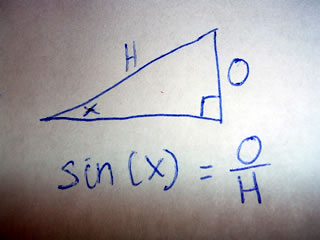
Thus if O=6 and H=10 then
sin(x) = 6/10
= 3/5
Thus if O=6 and H=10 then
sin(x) = 6/10
= 3/5
Friday, January 9, 2009
One to one functions (or injections)
A function f mapping the set A to the set B is said to be one to one, or an injection, if and only if (x,y) is in f and (z,y) is in f, implies that x=z.
Wednesday, January 7, 2009
Let I be an interval of the real line prove that the following function decreases on that line
Let I be an interval of the real line, that is to say, let I be a line somewhere on the line from negative infinity to positive infinity. Also let I be a subset of the domain of g (a function). It can be said that g is decreasing on I if and only if for all x,y that is an element of I, if x < y then g(x) > g(y).
Prove that g is decreasing on the set of real numbers where g(x)= 2 - 5x
Suppose that x < y then 5x < 5y and therefore 2-5x > 2-5y, and thus g(x) > g(y), so f is decreasing on the interval I and the set of real numbers.
Prove that g is decreasing on the set of real numbers where g(x)= 2 - 5x
Suppose that x < y then 5x < 5y and therefore 2-5x > 2-5y, and thus g(x) > g(y), so f is decreasing on the interval I and the set of real numbers.
Tuesday, January 6, 2009
Let I be an interval of the real line prove that the following function increases on that line
Let I be an interval of the real line, that is to say, let I be a line somewhere on the line from negative infinity to positive infinity. Also let I be a subset of the domain of f (a function). It can be said that f is increasing on I if and only if for all x,y that is an element of I, if x < y then f(x) < f(y).
Prove that f is increasing on the set of real numbers where f(x)= 3x - 7
Suppose that x < y then 3x < 3y and therefore 3x-7 < 3y-7, and thus f(x) < f(y), so f is increasing on the interval I and the set of real numbers.
Prove that f is increasing on the set of real numbers where f(x)= 3x - 7
Suppose that x < y then 3x < 3y and therefore 3x-7 < 3y-7, and thus f(x) < f(y), so f is increasing on the interval I and the set of real numbers.
Monday, January 5, 2009
Prove that two functions f and g are equal if and only if...
Prove that two functions f and g are equal if and only if
1. The domain of f is equal to the domain of g
and
2. for all x that are elements of the domain of f, f(x)=g(x)
The domain simply refers to the first coordinate for all coordinates in the function.
Proof:
Assume f=g
1. Suppose that x is an element in the domain of f, then (x,y) is an element of f for some y. Since we assume that f=g then (x,y) is also an element of g and x must be an element in the domain of g. Thus the domain of f must be a subset of the domain of g, and similarly g must be a subset of f. So the two domains are equal.
2. Again suppose that x is an element of the domain of f. Then for some y, (x,y) is an element of f. Since f=g, (x,y) must also be an element of g. Therefore f(x)=y=g(x)
1. The domain of f is equal to the domain of g
and
2. for all x that are elements of the domain of f, f(x)=g(x)
The domain simply refers to the first coordinate for all coordinates in the function.
Proof:
Assume f=g
1. Suppose that x is an element in the domain of f, then (x,y) is an element of f for some y. Since we assume that f=g then (x,y) is also an element of g and x must be an element in the domain of g. Thus the domain of f must be a subset of the domain of g, and similarly g must be a subset of f. So the two domains are equal.
2. Again suppose that x is an element of the domain of f. Then for some y, (x,y) is an element of f. Since f=g, (x,y) must also be an element of g. Therefore f(x)=y=g(x)
Sunday, January 4, 2009
Step Functions
Step functions can be seen as generalizations of characteristic functions.
Step functions can be expressed as b = {b sub a such that a has multiple definitions)
For example consider a set M equal to a coordinate [1,5] expressed on multiple sets Bsub1=[1,2]
Bsub2=[2,4]
Bsub3=[4,5]
Now let all the sub numbers be defined on the y axis as follows
Ysub(1)=3
Ysub(2)=4
Ysub(3)=2
The resulting graph would be a series from 1 to 5 on the horizontal x axis (set A) with a line going from 1 to 2 at point 3 on the y axis, and another line going from 2 to 4 at point 4 on the y axis, and then another line completing the "step" to 5 from 4 to 5 at point 2 on the y axis.
Step functions can be expressed as b = {b sub a such that a has multiple definitions)
For example consider a set M equal to a coordinate [1,5] expressed on multiple sets Bsub1=[1,2]
Bsub2=[2,4]
Bsub3=[4,5]
Now let all the sub numbers be defined on the y axis as follows
Ysub(1)=3
Ysub(2)=4
Ysub(3)=2
The resulting graph would be a series from 1 to 5 on the horizontal x axis (set A) with a line going from 1 to 2 at point 3 on the y axis, and another line going from 2 to 4 at point 4 on the y axis, and then another line completing the "step" to 5 from 4 to 5 at point 2 on the y axis.
Saturday, January 3, 2009
Characteristic Functions
Characteristic functions define the functions of sets and the functions of all object outside the set.
Take for consideration the set A that is part of the Universe. Then the characteristic function can be seen as
f(x)={1 if x is an element of A, and 0 if x is an element of everything but A, (or U-A)}.
Take for consideration the set A that is part of the Universe. Then the characteristic function can be seen as
f(x)={1 if x is an element of A, and 0 if x is an element of everything but A, (or U-A)}.
Friday, January 2, 2009
Constant Function
A constant function is a function with one codomain.
And example of this is the function f(x)=3
in set notation this would be
{(x,3) for all x that is an element of the real numbers}
as a graph it would look like a horizontal line where the vertical axis equals 3.
And example of this is the function f(x)=3
in set notation this would be
{(x,3) for all x that is an element of the real numbers}
as a graph it would look like a horizontal line where the vertical axis equals 3.
Thursday, January 1, 2009
Ranges and Codomains
Ranges and Codomains
The domain of a function can be seen as the first coordinate of an ordered pair, and the range cam be seen as the second coordinate. Thus for the ordered pair (3,5) 3 is the domain, and 5 is the domain. Every function can only have one domain and one range. Even though functions can have many many ordered pairs.
There can be, however, many co domains, as long as the function is a subset of the codomain. Consider the example:
A = {4,5,6}
B = {2,5,7}
Then the following two sets are functions of A and B with different codomains.
f1={(4,2),(5,5),(6,7)}
f2={(4,5),(5,7),(6,5)}
The domain of a function can be seen as the first coordinate of an ordered pair, and the range cam be seen as the second coordinate. Thus for the ordered pair (3,5) 3 is the domain, and 5 is the domain. Every function can only have one domain and one range. Even though functions can have many many ordered pairs.
There can be, however, many co domains, as long as the function is a subset of the codomain. Consider the example:
A = {4,5,6}
B = {2,5,7}
Then the following two sets are functions of A and B with different codomains.
f1={(4,2),(5,5),(6,7)}
f2={(4,5),(5,7),(6,5)}
Tuesday, December 30, 2008
Functions as Maps
Functions can also be seen as maps between two characteristics or variables. A function of A and B can also be called a mapping from A to B.
Thinking of this in set notation we can say that the range of a function is A, such that for every B (A,B) is an element of the function set.
Thinking of this in set notation we can say that the range of a function is A, such that for every B (A,B) is an element of the function set.
Monday, December 29, 2008
Functions
Function as a word was first used by Leibniz in 1694, and Euler popularized the notation f(x) in 1734. In terms of intuitive logic a function describes a rule of correspondence between two sets (i.e.: distance as a function of time).
Looking at functions in terms of relations a function f from A to B is a relation from A to B such that if (x,y) is an element in f and (x,z) is an element in f, then y = z. And also, the Dom(f) = A.
Looking at functions in terms of relations a function f from A to B is a relation from A to B such that if (x,y) is an element in f and (x,z) is an element in f, then y = z. And also, the Dom(f) = A.
Subscribe to:
Posts (Atom)

 Posts
Posts