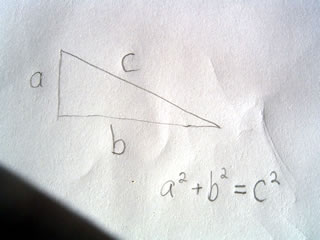
Thus if a=3 b=4 then c=5
We see 3^2 + 4^2 = 5^2 or 9 + 16 = 25
however, if b has a length of 5 (b=5) then we have
3^2 + 5^2 = 34 and the square root of 34 is 5.83095...
which isn't a whole number. Thus a right angled triangle with sides 3,4,5 is a Pythagorean triple, but a right angled triangle with sides 3,5,5.83095... isn't.
We can find Pythagorean triples (a,b,c) by taking any two whole number r and s, where r is greater than s (r > s)
then set
a= 2rs
b= r^2 - s^2
c= r^2 + s^2
As an example let r=5 and s=2
then
a=20
b=21
and
c=29
we see it is a Pythagorean triple because 20^2 + 21^2 = 29^2
or 400 + 441= 841
We can see how it works by plugging in the values for a and b.
Thus
a^2 + b^2 =
(2rs)^2 + (r^2 - s^2)^2 =
4(r^2)(s^2) + r^4 - 2(r^2)(s^2) + s^4 =
r^4 + 2(r^2)(s^2) + s^4 =
(r^2 + s^2)^2 = c^2
Thus
a^2 + b^2 = c^2


 Posts