Showing posts with label isosceles triangles. Show all posts

Sunday, January 25, 2009

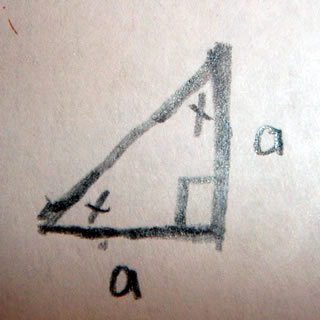
Prove that an isosceles right traingle has 45, 45, and 90 degree angles

Prove that an isosceles right triangle has 45, 45, and 90 degree angles.

sketch of an isosceles right triangle

Remembering what we know about isosceles triangles we can find any two angles of a triangle if we know one angle.

Thus since we know one angle is equal to 90 degrees, the remaining two angles are equal to each other, and all the angles of a triangle must equal 180 degrees, we can say

2x + 90 = 180

solving we get x=45

Thus the angles are 45, 45, 90

or Pi/4 , Pi/4 , Pi/2 radians.

The Pythagorean theorem can be written as follows for isosceles right triangles
2a2 = Hypotenuse2

Tuesday, January 13, 2009

Isosceles and Equilateral Triangles

Isosceles triangles are triangles with two sides of equal length. Therefore if we know the measure of one angle we can calculate the measure of the remaining angles. If we know that the measure of the unequal angle is 30 degrees we can deduce that the remaining angles must each equal 75 degrees.

Let x equal the measure of our two equal angles. This 2x + 30 must equal 180, or the total measure of degrees in a triangle.

2x + 30 = 180
2x=150
x=75


Equilateral triangles are triangles which have sides of equal length and therefore angles of equal length. The angles of an equilateral triangle will always equal 60 degrees or (pi)/3 radians.